

This week, we too are thinking about the tradition of tapestry-making — the way such pieces command a room, and the position they hold at the centre of fine art, design, and narrative.
Calder captures something a little more enigmatic, rather than the historic castles, horses, and battle scenes found in the medieval Bayeux Tapestry, currently on loan from France at the British Museum.
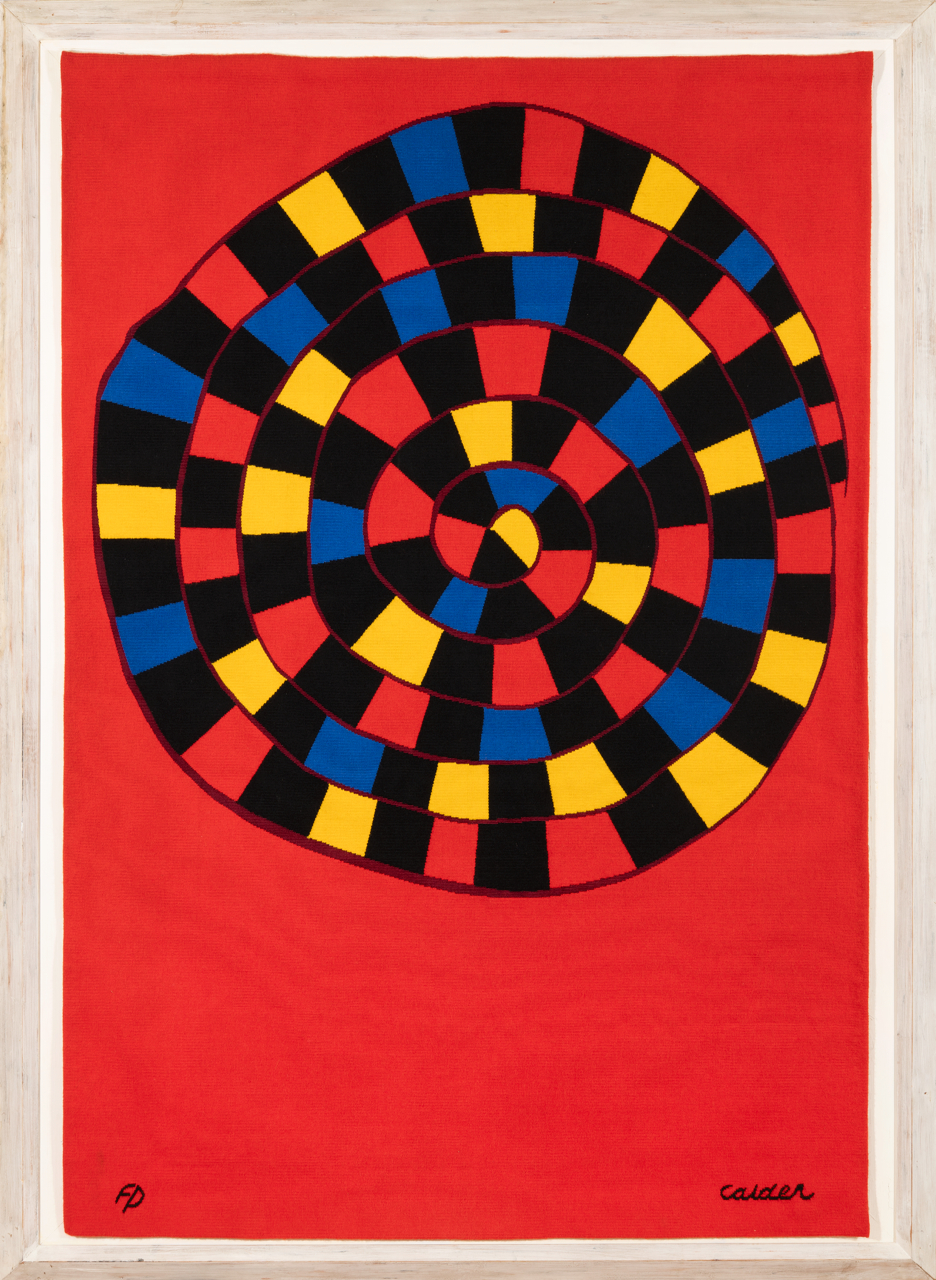
Against the bright red background sits the focal point of the piece: a swirling circle of black, yellow, red, and blue stripes. Almost hypnotic in it's movement, this snake-like symbol captures Calder's signature playful, kinectic compositions.
Just as tapestry is having a striking return to relevance in google searches and news articles today, thanks to the Bayeux Tapestry, the technique saw a significant revival in the world of modern art in the early to mid 20th century. Artists who expressed the essence of motion through striking compositions found their work translated seamlessly into tactile textures. It is no suprise therefore that Calder, famous above all for his floating mobiles, often experimented with new forms and materials with his work.
Calder joined this tapestry revival in the early 1960s. He began collaborating with legendary French weavers who could give his gouache studies rich texture and dimension.

The present work, Serpent au Vitral, was produced by Pinton Frères, whose principle commissions include tapestries in the Vatican, the French Embassy in Washington DC and The Fernand Leger Museum. Calder worked closely with the master weavers at Pinton Frères, discussing the design and colours as they transformed his modern graphic movements into monumental textiles.
His studies, prepared in colour on sheets of paper the size of his gouaches, functioned as maquettes. These were mechanically enlarged and hand-woven with wool in a limited edition of six copies, plus two artist's proofs.
Calder's tapestry occupies the room in the same epic way as the British Museum's display of the Bayeux Tapestry, although it doesn't measure 60 meters long. Serpent au Vitral is a grand display that demands to be experienced in person.
Our latest exhibition Alexander Calder: Art and Motion features Serpent au Vitral, alongside Calder's original gouaches, drawings, and a substantial body of lithographs.
