Discover the leading artists of the 20th and 21st centuries at Shapero Modern. From Pop icons such as Andy Warhol and Roy Lichtenstein to Modern Masters including Joan Miró and Pablo Picasso, our curated shortlist brings together the artists who consistently dominate the art market due to their unwavering demand and indisputable significance within the canon of art history.
Discover the leading artists of the 20th and 21st centuries at Shapero Modern. From Pop icons such as Andy Warhol and Roy Lichtenstein to Modern Masters including Joan Miró and Pablo Picasso, our curated shortlist brings together the artists who consistently dominate the art market due to their unwavering demand and indisputable significance within the canon of art history.
|
|
|
Louise Bourgeois (1911-2010)
|
|
| Louise Bourgeois was a pioneering French-American artist known for her deeply autobiographical and thought-provoking works. She frequently explored themes of femininity, memory, and trauma, with the spider emerging as a key motif symbolizing both maternal strength and fragility. |
|
|
Alexander Calder (1898-1976)
|
|
| Iconic sculptor and artist Alexander Calder is best known for his mobiles, which explore movement, balance and spatial interaction. His printed works are characterized by bold primary colours, geometric forms, and a sense of dynamism that maintains the lively essence of his sculptures in two dimensional form. |
|
|
David Hockney is one of the most influential British artists of the 20th and 21st centuries. Renowned for his distinctive style, he is celebrated for his use of bright, bold colour and playful, inventive compositions.
|
|
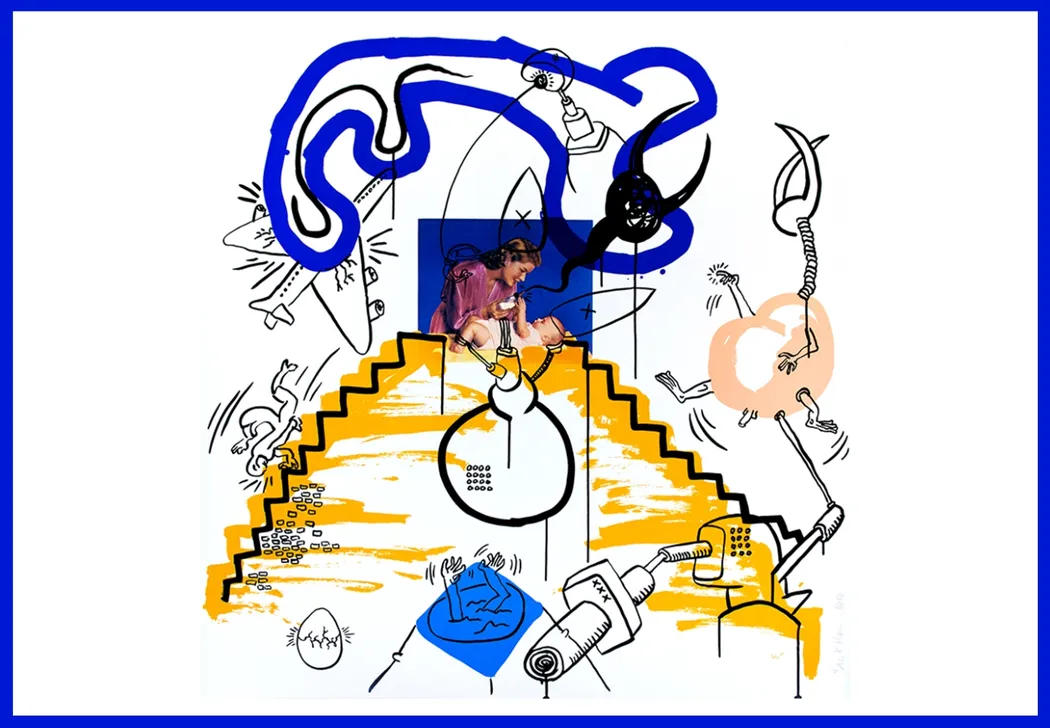
| Graffiti-inspired artist Keith Haring produced work at the intersection of art and activism, using his work to respond to social injustice and political events such as the AIDS epidemic, gay rights, drug abuse, and apartheid. His instantly recognisable cartoon-like style is defined by vibrant colours, bold black lines, and playful, energetic figures. |
|
| Alex Katz is known for his large-scale paintings that feature flat planes of rich, vibrant colour. His work simplifies people and everyday objects into bold, graphic forms with a striking sense of clarity. |
|
|
Roy Lichtenstein (1923-1997)
|
|
| A significant figure in the Pop Art movement, Roy Lichtenstein is celebrated for his iconic comic-book style and use of imagery influenced by mass production and advertising. The artist's characteristic aesthetic is at work in Shipboard Girl, which explores the mechanical aesthetics of industrial printing. |
|
| Joan Miró was a pioneering artist known for blending abstract and Surrealist styles in his work. His paintings feature biomorphic forms, geometric shapes, and bold primary colours, creating playful and highly characterful compositions. |
|
|
Pablo Picasso (1881-1973)
|
|
Undeniably one of the most influential artists of all time, Pablo Picasso was the pioneer of Cubism and master of representational abstraction. Picasso is celebrated for continuously redefining artistic boundaries. Through his relentless experimentation and innovation, he reshaped modern art and remains one of the most significant and enduring figures in art history.
|
|
| Frank Stella is an American painter and a key pioneer of Minimalism and post-painterly abstraction. His work is known for its bold geometric patterns and emphasis on pure form over narrative or emotion. |
|
|
Andy Warhol is one of the most iconic artists and a leading figure of the Pop Art movement. Fascinated by consumerism, celebrity culture, and mass media, he created vibrant, reproducible works that blurred the line between art and everyday life.
|
|
figure of the Pop Art movement. Fascinated by consumerism, celebrity culture, and mass media, he created vibrant, reproducible works that blurred the line between art and everyday life.


