
Frank Stella
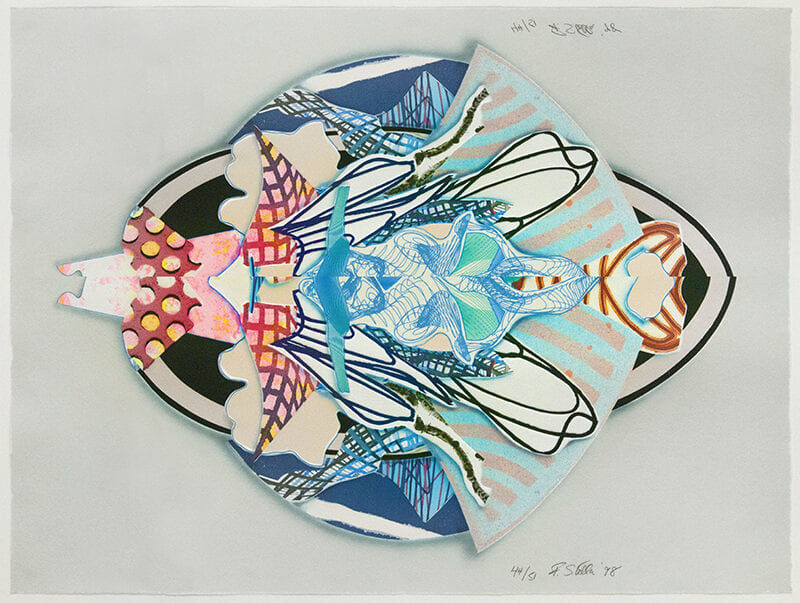
‘What you see is what you see’
Frank Stella was a pioneering abstract artist. Characterised by a series of dramatic style changes throughout his career, he originally began his career as an abstract-impressionist. Disillusioned with the homogeneity of the genre, he began to produce more minimalist works that focused on the formal elements of painting. Reducing his practice to pure form and colour over narrative and emotion, he began to create the series of formal geometric paintings he is well known for. Later in his career, Stella’s work evolved again into a form of art he termed ‘maximalism’, becoming more sculptural, featuring colourful reliefs and complex, interlocking shapes.
Stella’s first retrospective was held at the Museum of Modern Art (MoMA), New York in 1970 when he was aged just 33. He is still the youngest artist to have ever had a retrospective at MoMA and one of very few who have had the honour to have two, exhibiting there again in 1987. Since then, he has also had a retrospective at the Whitney Museum, New York (2015-2016) and several exhibitions at various galleries.
Related Artists
-
 River of Ponds I , 1971
 -
Les Indes Galantes: four prints, 1973
-
York Factory II, 1974
-
Lunna Wola (V), 1975
-
Sinjerli Variation Ia, from Sinjerli Variations, 1977
-
Sinjerli Variation IIa, from Sinjerli Variations, 1977
-
Yellow Journal, 1982
-
Swan Engraving Circle I, State V, 1983
-
The Waves: Squid, 1989
-
Libertinia, from Imaginary Places, 1995
-
Coxuria, from The Geldzahler Portfolio, 1997
-
Aiolio, from Imaginary Places III, 1998
-
Orofena, from Imaginary Places III, 1998
-
Paper Reliefs-Olyka (III), 1975 Sold
-
The Waves: The Quarter-Deck , 1989 Sold
-
The Waves: Going Abroad, 1989 Sold


Send me more information on Frank Stella
Stella was born in Malden, Massachusetts, attending high school locally at Phillips Academy in Andover. It was at school that he was intuitively drawn to artistic movement Abstract Modernism. He went on to attend Princeton University, majoring in History and visiting galleries and exhibitions in his free time. Stella moved to New York in 1958, where he began his artistic career.
Stella’s career broke through in the early 1960s, when he was included in several major exhibitions. A particularly seminal moment was his inclusion in the Shaped Canvas and Systemic Painting exhibitions at the Solomon R, Guggenheim Museum in 1965 and 1966 respectively. The Museum of Modern Art in New York held a retrospective titled Frank Stella in 1970, making him the youngest artist to receive a retrospective. In 1973, Stella had a print studio installed in his New York House and continued to experiment with lithography, screen-printing, etching and offset lithography, an engagement with print that had begun in the 1960s and which he returned to throughout his career. His canvases took on more abstracted forms alongside elements of collage and assemblage during this period. In 1969, Stella was commissioned to create a logo for the Metropolitan Museum of Art Centennial, which was imprinted on medals to mark the occasion.
Stella, the prominent abstract painter and sculptor, also made major contributions to the history of modern print – a biography of Stella would be incomplete without acknowledging this rich side of his artistic practice, with Stella himself commenting “the prints are in all of my work.” His collaboration with Kenneth Tyler in his printing has been termed one of “the great partnerships in modern American Art.” Tyler and Stella first begun to print together in 1967, at Gemini G.E.L in Los Angeles, and later at Tyler Graphics LTD in New York. Major art book on Stella’s print career (check book for refrenece nb) commented that “Tyler was a perfect match for Stella’s own restless and stylistic imagination.” Indeed, Tyler was such a major part of Stella’s print work that when Tyler Graphics LTD shuttered its doors in 2001, Stella stopped printwork. Over the course of a long partnership, however, Stella made huge contributions to print, recasting it from a mode of reproduction to a major artistic medium that was a force to be reckoned with in its own right. Stella experimented with rapid prototyping and 3-D printing, but later expressed exasperation for its limiting scale, and favoured colorprinting and screenprinting above all.
Stella held numerous solo exhibitions worldwide in the ensuing decades, including at the Phillips Collection, Washington D.C. (1973); the Baltimore Museum of Art, Baltimore (1976 – 1977); the Fort Worth Art Museum, TX (1978); the Museum of Modern Art, New York (1979); the Jewish Museum, Manhattan (1980); the San Francisco Museum of Modern Art, CA (1983) and at the Museum of Modern Art once again in 1988. Stella continues to exhibit internationally, with recent exhibitions including at the RA, London in 2015, the Whitney, New York in 2016 and at the Marianne Boesky Gallery, New York, in 2019.
Stella is collected internationally, with notable stock of his work owned by the Menil Collection, Houston; the Hirshorn Museum and Sculpture Garden, Washington D.C.; the San Francisco Museum of Modern Art, CA; the National Gallery of Art. UK; the Toledo Museum of Art and the Whitney Museum of American Art, New York.


-

Stella(r) Works
Summer Show 2026 Jun 25, 2026This week we shine the spotlight on Frank Stella (1936-2024), a groundbreaking and highly influential American artist whose work is wide-ranging in both style and media.Read more -
The Top 10 Blue Chip Artists
leading artists of the 20th and 21st centuries February 16, 2026Discover the leading artists of the 20th and 21st centuries at Shapero Modern. From Pop icons such as Andy Warhol and Roy Lichtenstein to Modern...Read more -

The Art of Frank Stella: Minimal, but make it Nautical!
the curious case of the artist’s ‘V Series’ November 10, 2025Frank Stella, Quathlamba II, from V Series, 1968 | Shapero Modern You wouldn’t usually expect to find the words ‘nautical’ and ‘minimal’ used together to...Read more -

'What is a Print?' by Gallery Director Tabitha Philpott-Kent
A glossary of modern art terminology June 25, 2021Artists have long supplemented their larger practice by making prints: original works, usually on paper, created in numbered editions and produced in collaboration with some...Read more
